Go to the content

Olympic MaaS

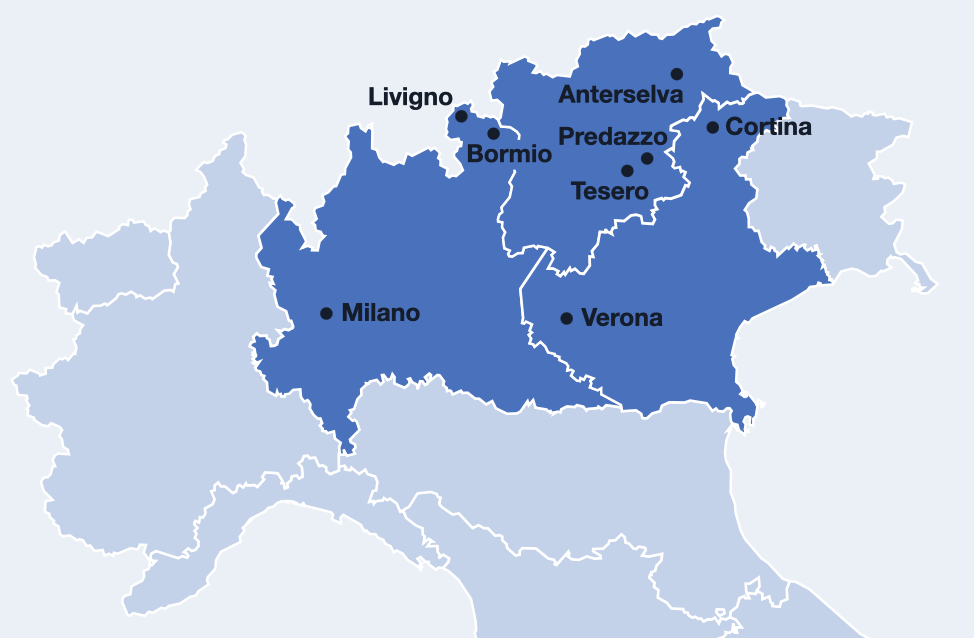
The Milano–Cortina 2026 Winter Olympics represent an international event of exceptional scale, not only because of the number of spectators and stakeholders involved, but also due to the logistical complexity that comes with it. For the first time in history, these are being described as “distributed Olympics”, because the Games will take place across a wide, fragmented territory, spread between urban hubs and Alpine locations: Milan, Cortina d’Ampezzo, Livigno, and Bormio are just some of the key reference areas.
This unique setup significantly amplifies the impact of mobility on the Olympic experience, because it requires reliable, continuous connections between places that differ greatly in distance, available infrastructure, and seasonality, clearly affecting travel for both spectators and accredited users (athletes, Olympic delegations, journalists).

In this context, mobility becomes a fundamental enabler of the Games: it must operate in a scalable way and be easy to understand for people coming from all over the world, ensuring a seamless experience for the general public while also maintaining high levels of control and security for accredited groups.

This unique setup significantly amplifies the impact of mobility on the Olympic experience, because it requires reliable, continuous connections between places that differ greatly in distance, available infrastructure, and seasonality, clearly affecting travel for both spectators and accredited users (athletes, Olympic delegations, journalists).

In this context, mobility becomes a fundamental enabler of the Games: it must operate in a scalable way and be easy to understand for people coming from all over the world, ensuring a seamless experience for the general public while also maintaining high levels of control and security for accredited groups.

Screenshot-2026-02-09-alle-19.24.40 Complete list of the venues during Milano-Cortina Olympics 2026
01

CHALLENGE

The main challenge of Milano–Cortina 2026 was, first and foremost, to provide digital services to very different audiences, each with distinct needs and expectations. On the one hand, for spectators, it was necessary to ensure a simple and immediate experience, with consistent, reliable, and real-time updated information, able to support travel between venues that are far apart as if they belonged to a single integrated system, across a multimodal offer that includes buses, trams, metro, shuttles and dedicated services, cars, and trains. On the other hand, for accredited users, in addition to the services described above, it was necessary to enable personalized features such as viewing dedicated transfer services and purchasing travel tickets.

This requirement was shaped by two major, closely interconnected layers of complexity. The first concerned the ecosystem: the Games required integrating, into a single platform, a variety of operators that differ significantly in service models, territorial coverage, and digital maturity, with the goal of ensuring a coherent experience across the entire Alpine macro-region involved. This heterogeneity was not only organizational, but also functional, because it meant bringing together different services and operational logics and making them interoperable with data and standards that were not always uniform, while preserving informational continuity and the quality of the user experience. The second crucial factor was time: the project had a compressed delivery window, with a start date tied to the opening of the Games and therefore effectively non-negotiable.

Further complicating the picture, the availability of “baseline” data was not sufficient: GTFS feeds for planned services alone often do not include essential elements for a complete experience, such as fares to correctly associate a price with the selected route, or shapes and metadata that help improve the quality and accuracy of journey planning. Moreover, in a high-pressure operational event, real-time information and service changes became decisive: disruptions, detours, and updates had to be communicated promptly and consistently across all channels, because any misalignment would immediately translate into impacts on the travel experience and, in turn, on the overall operations of the Games.

02

SOLUTION

Based on the challenges described, OpenMove designed and implemented, and today delivers and maintains, the mobility management platform for the Milano–Cortina 2026 Olympics. The platform is built to collect, normalize, and enrich data, and then expose it through APIs; in this way, heterogeneous sources are transformed into a single, consistent, reusable information asset that can be leveraged by the different channels and systems involved. This API-first approach is part of OpenMove’s DNA and aligns with the API ecosystem we have long made available at api.openmove.com, designed to enable rapid integration, reuse, and strong governance of mobility data.

The work starts with the acquisition of datasets from operators and event-specific services. The system verifies their quality and consistency and harmonizes them into standard formats, managing GTFS for scheduled services and GTFS-RT for real-time information, as well as shapes and fare information (Fares files) to correctly match routes and prices and improve the journey-planning experience.

On this foundation, OpenMove builds an API-first layer that makes data reliably available to third-party systems and different channels, including:

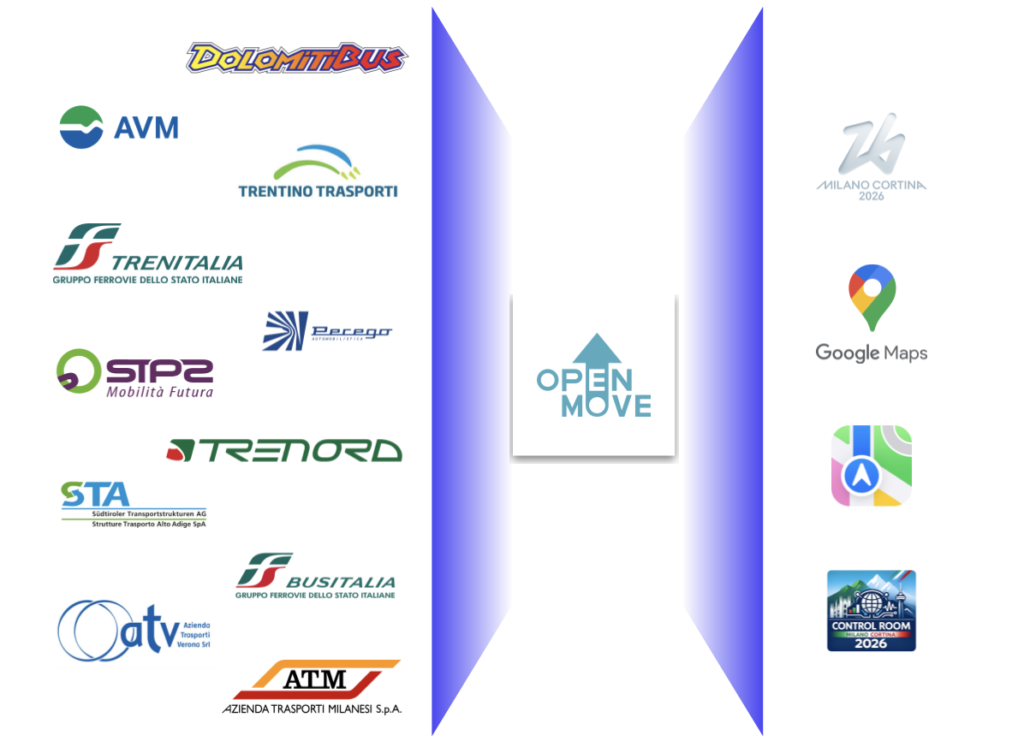
  • Apple and Google: for publishing and displaying transport information in Apple Maps and Google Maps.
  • Fondazione Milano Cortina administrative dashboard: designed for monitoring and operational management of services during the Games.
  • Dedicated app for accredited users: where, in addition to public mobility options, users can access dedicated services (such as official shuttles and transfers) and use in-app ticketing features for Trenitalia, ATM, and Trenord, ensuring an integrated and consistent experience across information, operations, and service usage.

The platform effectively enables an Olympic MaaS experience, where accredited users can plan multimodal journeys and access multiple services within a single digital experience, without being redirected to third-party solutions.

Screenshot-2026-02-10-alle-17.02.16-1024x753
3 integrations with the ticketing systems
6 mobility services
11 integrated transport operators
03

INNOVATION

The project’s innovation lies not only in data integration, but in the ability to turn data into an industrialized digital service, delivered with reliability and performance standards suited to a global event.

OpenMove adopts a cloud-native, API-first architecture in which the central backend, OpenMove NUCLEUS, collects, normalizes, and enriches mobility information, exposing it securely and consistently to heterogeneous platforms and applications (see OpenMove’s API page – api.openmove.com). In this model, APIs become critical infrastructure: they are designed to guarantee uptime of up to 99.99%, sustain loads on the order of millions of users per day, and maintain fast, stable response times (under 800 ms) even during peak moments, both for data access and for latency-sensitive services such as the journey-planning algorithm and real-time information updates.

This robustness is complemented by a key element: interoperability speed, i.e., the ability to connect and operationalize third-party systems in a very short time. Thanks to connectors, standardized flows, and structured data-ingestion processes, new sources and new stakeholders can be integrated quickly, drastically reducing timelines and complexity compared to traditional projects.

The result is a backend system that does not simply “publish” data, but makes it reliable, measurable, and scalable, with monitoring and resilience mechanisms designed to ensure operational continuity, informational consistency, and a smooth user experience across the entire digital chain—from journey planning to integrations with third-party systems.